
The short answer. Isolate the battery. Size the cable, then the fuse. Pick a terminal whose color matches the wire size and whose ring fits the stud. Strip just enough bare wire to fill the metal barrel. Crimp it in the matching color cavity of a ratcheting crimper. Give it a small tug. Shrink the tubing with a heat gun until the adhesive seals.
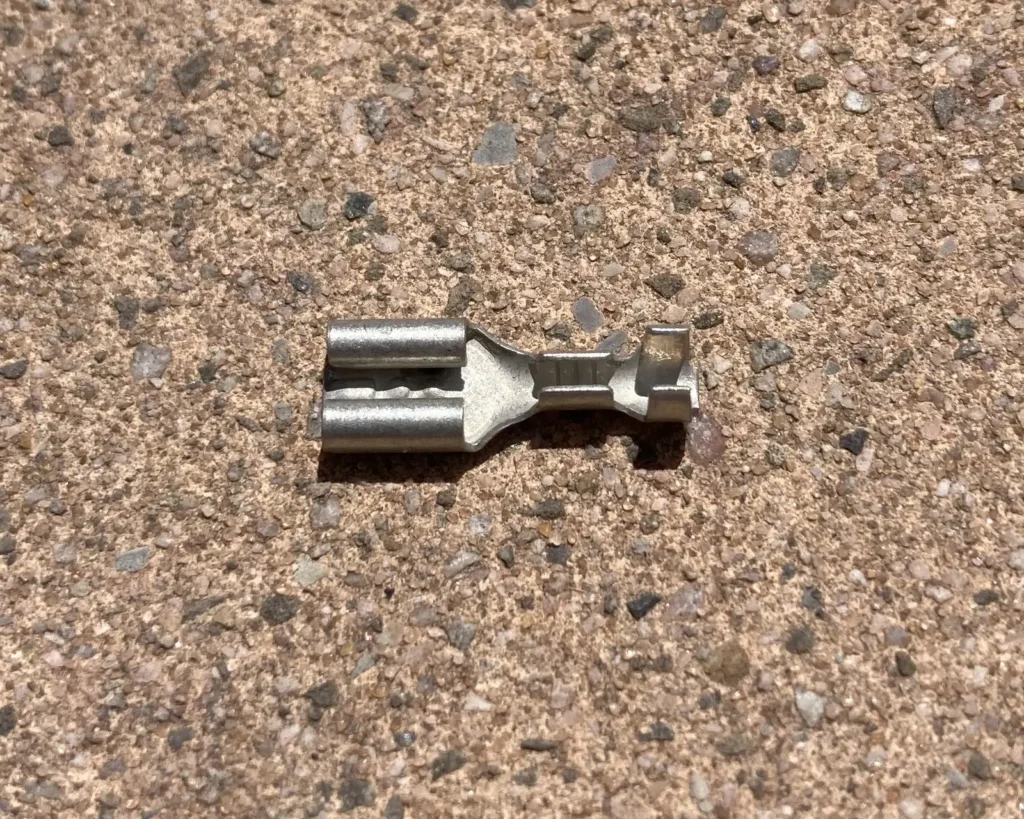
You’ll need
- Tinned, finely stranded marine wire (see Marine wire: why tinned, and which size)
- Heat-shrink terminals that match each wire and stud, from Marine wire and terminals
- A ratcheting crimper with color-coded cavities (red, blue, yellow), plus an 8 AWG cavity or a hex crimper if you use the 8 AWG rings
- For battery cable: tinned lugs, a hex lug crimper and adhesive-lined 3:1 heat-shrink tubing
- A wire stripper, a cable cutter and a heat gun
- The Wire gauge calculator and the Fuse size calculator
- Safety glasses
A good crimp is something you can see and test. You don’t need years of practice. You need the right terminal, the right die and a bit of patience. Here’s how.
How to crimp marine wire terminals, step by step
- Isolate the battery. Switch off the loads, open the battery switch and disconnect the battery negative. Leave it off until the last step.
- Size the cable, then the fuse. Put the amps and the round-trip length into the Wire gauge calculator. Once you know the wire size, pick the fuse that protects it with the Fuse size calculator. Cable first, fuse second.
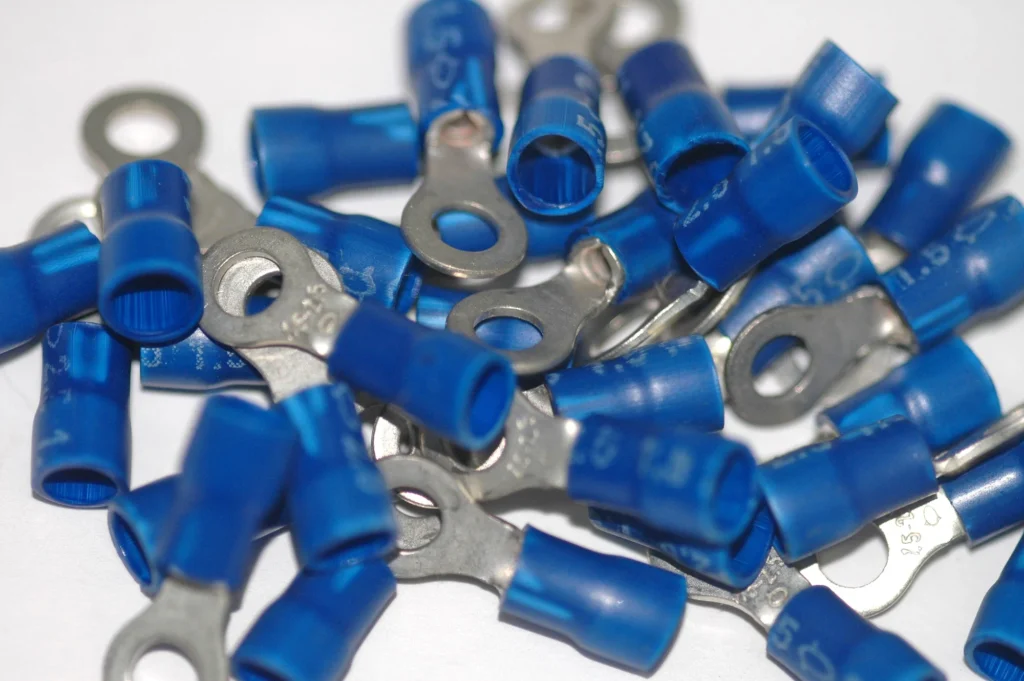
- Match the terminal to the wire. Pacer color-codes their heat-shrink terminals by wire size: red for 22-18 AWG, blue for 16-14 AWG, yellow for 12-10 AWG. Pacer’s heat-shrink line covers 22 to 8 AWG.
- Match the ring to the stud. A ring that fits the stud seats flat. Pacer heat-shrink ring terminal 16-14 AWG, 1/4 in stud is for a 1/4 inch stud. Pacer heat-shrink ring terminal 22-18 AWG, 3/8 in stud and Pacer heat-shrink ring terminal 8 AWG, 3/8 in stud fit 3/8 inch studs.
- Strip the wire. Pacer and Ancor don’t publish a strip length for these terminals. So check it against the terminal: the bare strands should fill the metal barrel, and the insulation should stop at the barrel’s end. Victron warns not to push the insulation too deep into the crimp. Don’t nick or cut strands.
- Crimp with the right die. Put the terminal in the cavity that matches its color. Pacer says the color stripe on the terminal tells you which die to use. Squeeze until the ratchet releases. Ancor’s ratcheting crimper won’t open until it has closed all the way, which is what makes the crimp consistent. If the terminal sits wrong, use the release lever and start again with a fresh terminal.
- Tug test. Victron calls a small tug on the wire after crimping good practice. If it moves, cut it off and redo it.
- Shrink it. Use a heat gun. Ancor’s manual says to keep the hand holding the wire out of the hot air and move the work side to side through the airflow until the tubing has shrunk. Pacer’s terminals shrink about 3:1 at 135°C, and the adhesive inside seals the joint.
- Let it cool, then fit it. Land the ring on its stud, then torque the nut to the number in that device’s manual.
- Reconnect the battery negative last. Then switch on and check each circuit.
Don’t overthink it. Do it the same way every time and the hundredth crimp looks like the first.
What’s the heat-shrink terminal color code?
| Color | Wire size | Our terminals |
|---|---|---|
| Red | 22-18 AWG | Pacer heat-shrink ring terminal 22-18 AWG, 3/8 in stud |
| Blue | 16-14 AWG | Pacer heat-shrink ring terminal 16-14 AWG, 1/4 in stud, Pacer heat-shrink male bullet 16-14 AWG, Pacer heat-shrink female bullet 16-14 AWG |
| Yellow | 12-10 AWG | Pacer heat-shrink butt connector 12-10 AWG |
Pacer’s 8 AWG terminals are pink, outside the red-blue-yellow set. Use a crimper cavity marked for 8 AWG.
Which crimper should I use?
A ratcheting one. Victron’s Wiring Unlimited says to use a professional ratcheting crimp tool, because the ratchet applies the right pressure every time. Plain pliers squeeze as hard as your hand does that day.
Ancor’s catalog adds two points:
- Its ratcheting crimpers have 4 color-coded cavities, one per wire range.
- It quotes ABYC recommending a crimp tool made by the same brand as the connectors.
Pacer lists a crimper that crimps just the conductor part of insulated terminals, color-coded red, blue and yellow, as a good match for heat-shrink terminals. Victron notes that standard crimp terminals have two crimp zones: the bare core gets one and the insulation gets the other. Your terminal’s maker tells you which one applies.
How do I crimp battery cable lugs?
Same idea, bigger tools. Isolate the battery first, every time.
- Size the cable with the Wire gauge calculator, then the fuse with the Fuse size calculator.
- Match the lug to the cable and the stud. Victron says the lug must match the cable’s thickness. Pacer tinned battery lug 2/0 AWG, 3/8 in stud fits 2/0 cable on a 3/8 inch stud. It’s tin plated with a closed end and no exposed seams.
- Slide the heat-shrink tubing on first. Bare lugs need it. Do it before you crimp, or you can’t get it over the lug.
- Strip so the bare cable fills the lug barrel to the bottom, with no insulation inside.
- Crimp with a lug crimper. Victron says to use a special crimping tool on lugs. Ancor makes hex crimpers for 8 to 4/0 AWG, and Pacer lists battery lug crimpers with a crimp-depth adjustment. Use the die or setting for your cable size.
- Tug test the same way.
- Cover it. Victron says to add insulation to an uninsulated lug. Pacer’s adhesive-lined 3:1 tubing seals out moisture. Shrink it over the barrel and onto the cable jacket.
- Reconnect the battery negative last. Then switch on and check the circuit.
How do I stay safe doing this?
- Battery negative off first, on last. A wrench across a live terminal makes a lot of current, fast.
- Mind the heat gun. Ancor’s manual says not to run it near flammable liquids, gases or dust, so no heat gun near fuel vapor. The air can reach 932°F, and the nozzle can need 20 minutes or more to cool. Set it down pointing up, on a stable surface.
- Wear eye protection. Strands and clipped ends fly.
- AC is different. Shore power and anything on the AC side is a job for a licensed marine electrician.
Does this fit your job?
This applies if: – You’re making DC connections on a boat, van or RV with 22-8 AWG wire, or battery cable up to 2/0. – You use tinned, finely stranded marine wire.
This doesn’t apply if: – The job is shore power or AC wiring. That goes to a licensed marine electrician. – The terminal maker gives different instructions. Follow the maker of the part in your hand.
Products used in this guide
| Product | What it’s for |
|---|---|
| Pacer heat-shrink ring terminal 22-18 AWG, 3/8 in stud | Small signal and light wires on a 3/8 inch stud. |
| Pacer heat-shrink ring terminal 16-14 AWG, 1/4 in stud | Pumps, lights, fans on a 1/4 inch stud. |
| Pacer heat-shrink ring terminal 8 AWG, 3/8 in stud | 8 AWG feeds on a 3/8 inch stud. |
| Pacer heat-shrink butt connector 12-10 AWG | Sealed splice for 12-10 AWG. |
| Pacer heat-shrink male bullet 16-14 AWG | One half of a plug-apart joint. |
| Pacer heat-shrink female bullet 16-14 AWG | The other half. |
| Pacer tinned battery lug 2/0 AWG, 3/8 in stud | Battery cable ends. Seal with 3:1 tubing. |
Prices show live from the store. The full range is in Marine wire and terminals.
Quick answers
Should I solder heat-shrink terminals too? They’re made to be crimped and then shrunk. Follow the steps above with the right crimper.
How do I know which die to use? Match colors. The terminal’s color stripe shows the die, and the crimper cavities are colored red, blue and yellow.
Is a tug test enough? It’s the quick field check Victron suggests. If the wire moves at all, cut it and crimp a new terminal.
What temperature shrinks heat-shrink terminals? Pacer’s shrink about 3:1 at 135°C. A heat gun gets there quickly, so keep the work moving through the air.
Can I crimp battery lugs with a hammer crimper? Pacer and Ancor list lever and hex crimpers for battery lugs, and Victron says to use a special crimping tool. Use one of those.
Related guides: Marine wire: why tinned, and which size
Sources
- Pacer 2025 product catalog: https://www.pacergroup.net/content/catalog.pdf
- Victron Wiring Unlimited, DC wiring: https://www.victronenergy.com/media/pg/The_Wiring_Unlimited_book/en/dc-wiring.html
- Ancor Catalog 2024, page 50: https://docs.navico.com/view/362211770/50/
- Ancor heat gun operator’s manual: https://www.navico.com/content/dam/navico/integrated-sites/ancor/resources/products/tools-and-testers/Ancor-ZX476.pdf