
The short answer. For a house bank you cycle often, lithium (LiFePO4) wins on almost every number: about five to eight times the cycles at the same depth of discharge, roughly a third of the weight for the same usable amp-hours, and it doesn’t mind sitting half charged. Lead-acid still fits engine starting, charging below freezing, and boats used a few weekends a year.
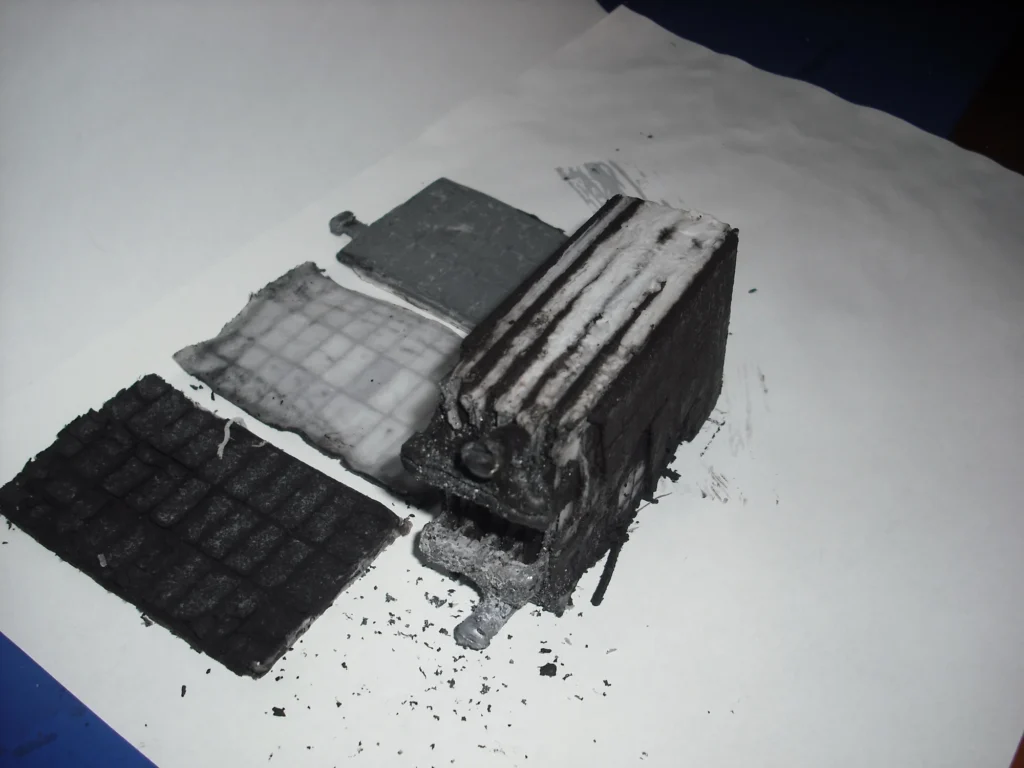
The age of the lead battery is dead
That’s our line, and for house banks we mean it. But you shouldn’t have to take our word for it. So here are both chemistries side by side, from one maker’s own datasheets, so you can make the call yourself.
We picked Victron because it makes both. Its Lithium Battery Smart (LiFePO4) and its AGM, gel and AGM Super Cycle batteries are tested and published by the same company. That’s as close to apples to apples as you’ll get. Where the test conditions differ, we say so.
We don’t sell lithium batteries. We sell the gear around them: the monitor, the chargers, the fuse and the switch. So we’ve got no reason to oversell the battery itself.
What you need to know first
- LiFePO4 is the lithium type used in most boat, van and RV house batteries. A 12V one is four cells of 3.2V each, so it’s labeled 12.8V (S1).
- AGM and gel are both sealed lead-acid. Victron calls them VRLA. AGM handles big, short currents better; gel lasts longer in cycling and float use (S3).
- Depth of discharge (DoD) is how much of the rated capacity you use before recharging. Every cycle life number depends on it, so always compare at the same DoD.
Lithium vs lead-acid: the numbers side by side
All figures are for 12V batteries, from Victron’s own documents.
| Lithium (Victron LiFePO4 Smart) | Lead-acid (Victron AGM / gel) | |
|---|---|---|
| Cycles at 80% DoD | 2,500 | AGM 400, gel 500 |
| Cycles at 50% DoD | 5,000 | AGM 600, gel 750 |
| Cycles at 100% DoD | Not listed | AGM Super Cycle: at least 300 |
| Weight, about 100Ah | 14 kg (30.9 lb) for 100Ah | 26 kg (57.3 lb), Super Cycle 100Ah |
| Weight for about 80 usable Ah | 14 kg (30.9 lb): 100Ah used to 80% | 47 kg (103.6 lb): AGM 165Ah used to 50% |
| Capacity under a heavy load | Rated at discharge up to 1C (100A on a 100Ah battery) | Rated at a 20-hour discharge. AGM gives 85% of that over 5 hours and 65% over 1 hour |
| Charging temperature | +5 to +50°C (41 to 122°F) only | No low cutoff listed; charge voltage needs temperature compensation below 10°C or above 30°C |
| Capacity in the cold | 80% at 0°C, 50% at -20°C | Drops sharply in the cold (Victron shows a graph, no table) |
| Charge voltage | 14.0-14.4V (14.2V recommended), 2 hours absorption, float 13.5V | AGM absorption 14.2-14.6V, float 13.5-13.8V, storage 13.2-13.5V |
| Charge current, 100Ah battery | Recommended up to 50A, max 100A | Preferably no more than 0.2C (20A) |
| Round-trip efficiency | 92% | 80% for the average lead-acid battery |
| Sitting unused | Store up to 1 year at 25°C, fully charged | Under 2% self-discharge a month at 20°C, doubling every 10°C warmer; up to a year if kept cool |
| Left partly charged | Fine. Victron says service life slightly improves | Wears out early from sulfation |
| Engine starting | No cranking rating on the datasheet | Recommended for engine starting; Super Cycle 100Ah lists 500 CCA |
Sources: lithium column S1 and S2; lead-acid column S3 and S4. The efficiency row comes from Victron’s lithium datasheet, which gives both numbers. Pounds and °F are our conversions.
Where the test conditions differ
The two sheets don’t test the same way, and that’s worth knowing before you lean on any one row.
- End of life. Victron counts lithium cycles until capacity falls to 80% of nominal. The AGM and gel sheet doesn’t say where it counts a battery as worn out.
- Discharge rate. Lithium capacity is rated at up to a 1C discharge and 25°C. Lead-acid capacity is rated over 20 hours. Run them both hard and the lead-acid battery loses more, which the “heavy load” row shows.
- Super Cycle tests. The AGM Super Cycle numbers come from discharging and recharging at 0.2C, with a two-hour rest when empty for the 100% test. They’re listed at 40, 60 and 100% DoD, not 50 and 80, so they sit in their own row.
Even with those caveats, the gap is wide: 2,500 cycles against 400 at the same 80% depth.
100Ah lead-acid vs 100Ah lithium: usable amp-hours
Here’s the comparison most people actually want. Same label, 100Ah. How much do you really get?
Lead-acid: Victron AGM Super Cycle 100Ah. Victron recommends it where you’ll often use 60 to 80% of the battery, and rates it for at least 700 cycles at 60% DoD (S4).
- Usable per cycle: 100Ah × 60% = 60Ah
- Over its rated cycles: 60Ah × 700 = 42,000Ah
- Weight: 26 kg (57.3 lb)
- Under a heavier load it shrinks: the same battery gives 82Ah, not 100, over a 5-hour discharge.
Lithium: Victron LiFePO4 Smart 12.8V 100Ah. Rated for 2,500 cycles at 80% DoD (S1).
- Usable per cycle: 100Ah × 80% = 80Ah
- Over its rated cycles: 80Ah × 2,500 = 200,000Ah
- Weight: 14 kg (30.9 lb)
- Rated capacity holds at discharge currents up to 100A.
So the lithium battery gives a third more usable amp-hours each night, close to five times the total amp-hours over its rated cycles, and weighs about half as much. Same label on both.
Use the Battery bank size calculator to run this with your own daily load.
Where lithium clearly wins
Boats and RVs that sit half charged. Victron’s own lithium sheet says lead-acid fails early when it’s rarely fully charged, or left part charged through a winter. Lithium doesn’t care. That describes a lot of boats: they come home part charged and wait for next weekend.
Solar. Victron gives lead-acid an 80% round-trip efficiency on average and lithium 92%. It also says lead-acid charging gets worse past 80% charged, down to 50% or less in solar systems kept between 70 and 100% (S1). Lithium still gets about 90% there. On a small roof with limited panels, that difference is real energy.
Weight. For about 80 usable amp-hours, 14 kg of lithium against 47 kg of AGM. On a small boat, a van or a trailer with a tight cargo limit, that’s the whole argument.
Fast charging. A 100Ah AGM should take about 20A. A 100Ah lithium takes up to 50A as the recommended rate. Your engine run or generator hour puts more into the bank.
Heavy loads. An inverter running a microwave or a windlass pulls hard. AGM gives about 65% of its rated capacity over a one-hour discharge. Lithium’s rating already assumes loads that heavy.
When lead-acid still makes sense
Lead-acid isn’t finished everywhere, though. Four honest cases:
Starting batteries
Victron recommends its AGM for high-current jobs like engine starting, and lists cold cranking amps for it: 500 CCA for the 100Ah Super Cycle (S3, S4). Its lithium datasheet lists no cranking rating at all. Many boats that go lithium keep a lead-acid start battery and use lithium only for the house loads. That’s the setup in Boat lithium battery wiring diagram: 2 simple setups.
Charging below freezing
Victron’s lithium battery may only be charged from +5°C to +50°C (41 to 122°F). Its manual says charging below 5°C does permanent damage to the cells, and setting the limit lower voids the warranty (S2). Discharging is fine down to -20°C.
If your solar or alternator needs to charge a battery in a cold engine room or an unheated RV bay through winter, lead-acid handles that more simply. Some lithium batteries come with heaters or a low-temperature cutoff built in. Check what your maker says, and match it.
An old alternator you won’t change
Victron’s manual puts it plainly: lithium has very low internal resistance and takes a much higher charge current than lead-acid, so care is needed not to overload the alternator. Its fixes are a temperature-controlled alternator regulator, a current-limiting DC-DC charger, or a BMS with an alternator port (S2).
If you won’t add any of those, keep lead-acid on that alternator. Don’t wire lithium straight to an alternator built for lead-acid.
A tight budget and light use
Victron says it outright on its lithium datasheet: lithium is expensive compared to lead-acid, and pays back in demanding uses. A boat out a few weekends a year isn’t always one.
Do the math with Victron’s numbers. Say you cycle a deep-cycle AGM to 50% about 30 times a year. At 600 rated cycles, that’s 20 years of cycling. But Victron rates that AGM for 7 to 10 years of float life at 20°C, and only 4 years at 30°C. The battery ages out long before it cycles out. In that case the cheaper battery may be the right call, and you spend the money on a good charger and a monitor instead.
What has to change when you switch
Swapping the battery is the easy part. The gear around it is what makes lithium work, and you can fit all of it yourself.
You’ll need:
- A battery monitor: Victron SmartShunt 500A
- A DC-DC charger: Victron Orion-Tr Smart 12/12-30 isolated DC-DC
- A shore charger you can set for lithium: Victron Blue Smart IP22 12/30 charger
- A solar controller you can set: Victron SmartSolar MPPT 100/30
- A main fuse and battery switch, plus cable sized with the Wire gauge calculator
- A low-voltage cutoff: Victron Smart BatteryProtect 100A
Then take it one step at a time, in this order:
- Add a battery monitor that counts amps. Victron’s manual says its lithium battery doesn’t work out its own state of charge, so add a SmartShunt or a BMV (S2). The SmartShunt reads out to your phone. SmartShunt vs BMV-712 vs BMV-700 helps you pick.
- Put a DC-DC charger off the alternator. The Orion-Tr limits the charge to 30A and keeps the start battery separate. Charging lithium from a boat alternator: Orion-Tr vs Cyrix vs combiner goes through the choices.
- Set the shore charger to a lithium profile. Lithium wants 14.2V for 2 hours, then 13.5V, and no equalize. If yours can’t be set that way, the Blue Smart IP22 can.
- Set the solar controller. Same voltages. The SmartSolar MPPT lets you set them.
- Fit a main fuse and switch sized for lithium. Victron describes lithium as having very low internal resistance, so a short can draw a huge current. The main fuse at the battery has to be rated to break it. A battery switch goes after that fuse; the Boat lithium upgrade kit includes one.
- Add a low-voltage cutoff for loads. The BatteryProtect shuts loads off before the battery goes too low.
Upgrading a boat to lithium: everything around the battery covers each step in detail. Or start from the Boat lithium upgrade kit and leave out what you already have.
Last check before you close the locker: Victron’s lithium battery is rated IP22 and its manual says it isn’t for outdoor use. Mount any battery where its own sheet says it can live, out of bilge water and spray.
Does this comparison fit your setup?
This applies if: – You run a 12V house bank on a boat, van, camper or RV. – You’re deciding between LiFePO4 and AGM or gel for that house bank. – You cycle the bank often, or it sits partly charged between trips.
This doesn’t apply if: – You’re choosing an engine start battery only. Follow the engine maker’s cranking spec. – Your batteries live where they’d need charging below freezing and the lithium battery you’re looking at has no heater or low-temperature cutoff. – You run 24V or 48V, or a large bank in series. The maker’s system guide comes first. – You’re looking at other lithium types (not LiFePO4). The numbers above don’t carry over.
Products used on this page
| Product | Why it’s here |
|---|---|
| Victron SmartShunt 500A | Counts amps in and out so you know the real state of charge. |
| Victron Orion-Tr Smart 12/12-30 isolated DC-DC | Charges lithium from the alternator at a set 30A. |
| Victron Blue Smart IP22 12/30 charger | Shore charger with a lithium profile. |
| Victron SmartSolar MPPT 100/30 | Solar controller you can set to your battery maker’s voltages. |
| Victron Smart BatteryProtect 100A | Cuts loads before the battery runs too low. |
Prices show live from the store.
Bundles for this job: Boat lithium upgrade kit, small, Boat lithium upgrade kit, large
Quick answers
How many more cycles does lithium get than AGM? At the same depth, a lot more. Victron rates its LiFePO4 battery for 2,500 cycles at 80% DoD and its AGM for 400. At 50% DoD it’s 5,000 against 600.
How much of a 100Ah lithium battery can I use? Victron’s cycle rating is built around using 80%, which is 80Ah, for 2,500 cycles. Its AGM Super Cycle 100Ah is rated at 60% use, or 60Ah, for 700 cycles.
Can I charge a lithium battery below freezing? Not Victron’s. It charges only from +5°C to +50°C, and its manual says charging colder than that damages the cells. Some other lithium batteries come with built-in heaters, so check that battery’s own datasheet.
Can lithium start my engine? Victron lists no cranking rating for its lithium battery, and recommends AGM for engine starting. Many setups keep a lead-acid start battery and charge the lithium house bank through a DC-DC charger.
Do I need a new charger to switch to lithium? Maybe. Lithium wants about 14.2V absorption for 2 hours, a 13.5V float and no equalize stage. If your charger can’t be set to that, replace it. Check your battery maker’s numbers first.
Is lithium worth it for an RV I use a few weekends a year? Sometimes not. A lightly used AGM tends to age out (Victron rates 7 to 10 years of float life at 20°C) before it uses its 600 cycles at 50%. If you boondock, run solar or care about weight, lithium is far more likely to earn its cost.
Sources
- Victron 12.8 and 25.6 Volt Lithium-Iron-Phosphate Batteries Smart datasheet: https://www.victronenergy.com/upload/documents/Datasheet-12,8-&-25,6-Volt-lithium-iron-phosphate-batteries-Smart-EN.pdf
- Victron Lithium Battery Smart manual: https://www.victronenergy.com/upload/documents/Lithium_Battery_Smart/15958-Manual_Lithium_Smart_Battery-pdf-en.pdf
- Victron Gel and AGM Batteries datasheet: https://www.victronenergy.com/upload/documents/Datasheet-GEL-and-AGM-Batteries-EN.pdf
- Victron AGM Super Cycle battery datasheet: https://www.victronenergy.com/upload/documents/Datasheet-AGM-Super-Cycle-battery-EN.pdf