
The short answer. The fuse protects the cable. Victron’s rule for a single device: the fuse matches the device’s current rating or the cable’s, whichever is lower. If the product’s manual names a fuse size, use that. Put it on the positive cable, close to the battery or busbar.
Pick a product, or enter the currents.
The fuse protects the cable, so it goes on the positive cable as close to the battery or busbar as you can fit it. Your device’s manual and your battery maker’s manual have the final say. Guidance, not a substitute for a qualified electrician. On a boat, when in doubt, ask an ABYC-certified marine electrician.
Guidance, not a substitute for a qualified electrician. On a boat, when in doubt, ask an ABYC-certified marine electrician.
Two ways in
Pick your product. For the chargers, solar controllers and inverter-chargers on our list, the tool shows the fuse size printed in Victron’s own manual. The Orion-Tr 12/12-30 takes a 60 A fuse on each side. A SmartSolar MPPT 100/30 takes 35 to 40 A on the battery side. A MultiPlus 12/2000 takes 300 A.
Two products don’t get a number, and the tool says why: the Phoenix 12/1200’s manual says to fit an external fuse close to the battery without giving a size, and the Smart BatteryProtect’s says to follow local regulations.
Enter the currents. For anything else, enter the device’s maximum current from its manual and the cable’s current rating from the cable maker’s sheet. The fuse has to be at least the device’s current, or it blows in normal use, and no more than the cable’s, or it doesn’t protect the cable. The tool lists the smallest standard size in that window from each fuse family. If the cable is rated below the device, no fuse fits, and the answer is a bigger cable. The Wire gauge calculator sizes it.
Which kind of fuse
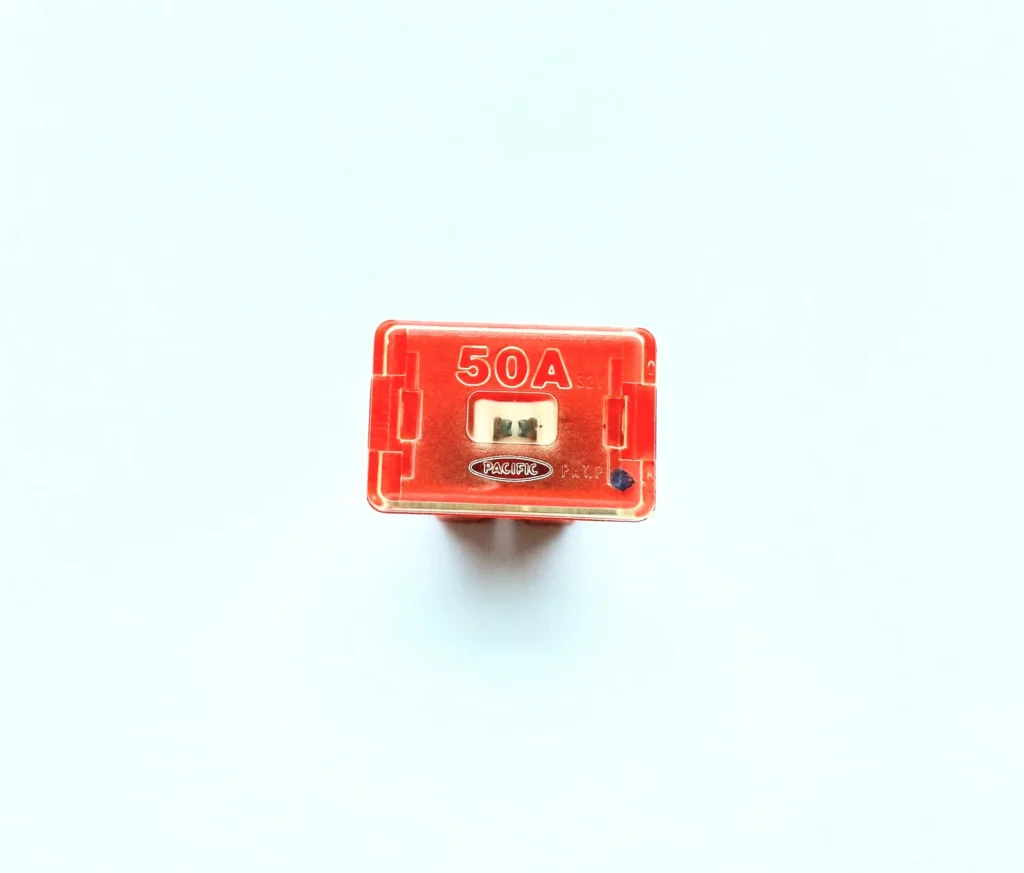
The tool only offers sizes the fuse makers actually sell, and only families rated for your system voltage:
| Family | Sizes the maker lists | DC interrupt rating (maker) |
|---|---|---|
| ATO/ATC blade (Littelfuse) | 1 to 40 A | 1,000 A at 32 V |
| MAXI blade (Littelfuse) | 20 to 80 A | 1,000 A at 32 V |
| MRBF terminal fuse (Egis) | 30 to 300 A | 10,000 A at 14 V |
| ANL (Eaton Bussmann) | 35 to 750 A | 2,700 A |
| Class T (Eaton Bussmann) | 15 to 600 A in this tool | 20,000 A |
Small branch circuits can go on blade fuses in a block like the Egis RT 12-position fuse block with ground. Heavy feeds go on ANL in the Egis ANL fuse block, up to 4/0, 35-750A.
Lithium changes the main fuse
A lithium bank can deliver a huge current into a dead short. Victron’s Wiring Unlimited says that in every lithium installation, at least one fuse in the DC line must have an interrupt rating at or above the bank’s maximum short-circuit current. That number comes from your battery maker, and it decides whether your main fuse is a class T, an MRBF or something else. The Fusing a lithium bank: Lynx, MRBF and class T goes through it.
Bundles for this job: Wiring and fusing kit (12-circuit panel)
Quick answers
What size fuse for a Victron MPPT 100/30? Victron’s manual gives 35 to 40 A on the battery side. The cable it protects has to be rated for at least that.
What size fuse for an Orion-Tr 12/12-30? Victron’s manual gives 60 A, on both the input and the output cable.
Where does the fuse go? On the positive cable, as close to the battery or busbar as you can fit it, per Victron. Every device gets its own fuse.
Can I use a bigger fuse so it stops blowing? Not bigger than the cable’s rating. If a correctly sized fuse keeps blowing, the device draws more than you thought, or there’s a fault. Find out which before you change anything.
Sources
Victron product manuals and Wiring Unlimited; Littelfuse ATOF 287 and MAXI 299 datasheets; Eaton Bussmann ANL and JJN class T data sheets; Egis 3603 MRBF page. Links and exact quotes in calculators/data/fuses.json.