
The short answer. Yes, your boat’s alternator can charge a lithium house bank. Just not through a straight wire. Put a DC-DC charger like the Victron Orion-Tr Smart between the start battery and the lithium bank. It caps the current and charges with a lithium profile. A plain combiner caps nothing.
You’ll need
- A DC-DC charger: Victron Orion-Tr Smart 12/12-30 isolated DC-DC
- Two fuses, one near each battery, sized from the charger’s manual
- Tinned cable sized with the Wire gauge calculator
- A way to see what’s going in: Victron SmartShunt 500A
- Your lithium battery maker’s charge voltages, from its manual
You’ve got three ways to get engine charge into a lithium bank:
- a plain combiner or voltage-sensing relay
- a lithium-aware combiner, like Victron’s Cyrix-Li-ct
- a DC-DC charger
They look alike on a wiring diagram. They act very differently once the engine is running and the bank is low. Here’s what each one does, which one fits your boat, and how to fit a DC-DC charger yourself, step by step.
This guide sticks to that one choice. For everything else that changes when you go lithium, see Upgrading a boat to lithium: everything around the battery.
Can I charge lithium straight from my alternator?
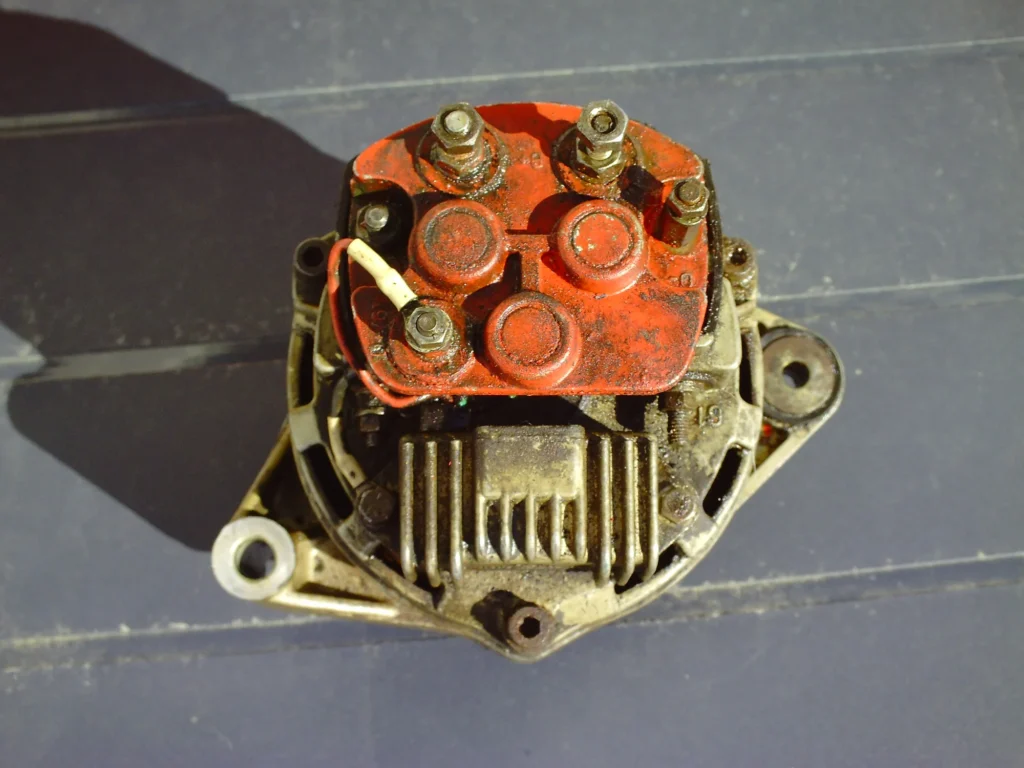
Not safely on most boats. Here’s why. Your alternator was built for lead-acid. A lead-acid battery pushes back as it fills, so the current tapers off on its own. A lithium battery barely pushes back. It takes whatever the alternator can make, for most of the charge.
Victron’s Orion-Tr manual says it plainly: direct charging “can overload the alternator” because of the lithium battery’s low impedance. Run flat out for a long stretch, the alternator gets hot, and the same manual notes that a hot alternator gives less output.
There’s a second catch. Every lithium battery has a battery management system (BMS) that can disconnect it to protect the cells. If that happens while the alternator is pushing hard, the alternator loses its load in an instant. That spike is why Victron built a voltage suppressor into its lithium combiner (more on that below).
So something has to sit between the alternator and the lithium bank. Here are your three choices.
Option 1: plain combiner or voltage-sensing relay
A combiner (Victron calls it a battery combiner; you’ll also hear voltage-sensing relay, VSR or split-charge relay) is a heavy-duty switch. When it sees charging voltage on one battery, it joins the two batteries together. When the voltage drops, it splits them again.
Victron’s plain Cyrix-ct 12/24-120 works this way. Its datasheet gives:
- 120 A continuous, 180 A for 5 seconds of cranking
- Connects between 13 V and 13.8 V and disconnects between 11 V and 12.8 V on a 12V system, using voltage trend, not one fixed point
- A start-assist input that holds it closed for 30 seconds if your start battery is flat
- It won’t close if either battery connection reads under 2 V on a 12V system, and it opens if its contacts get too hot
Notice what it doesn’t do: limit current. Once it closes, the lithium bank is wired to the alternator as if by a plain cable.
Victron’s datasheet describes the Cyrix-ct linking a starter battery to an accessory battery, a bow thruster battery, or other batteries. It doesn’t mention lithium anywhere. Victron makes a separate model for lithium, covered next. So we only point people to the plain Victron Cyrix-ct 12/24V 120A for a lead-acid job, like charging a lead-acid thruster or windlass battery off the engine. Not for a lithium house bank.
Option 2: a lithium combiner (Cyrix-Li-ct)
Victron’s lithium version, the Cyrix-Li-ct 12/24-120, joins a lead-acid starter battery and a LiFePO4 battery. The difference is the extra signal it listens to. According to the datasheet, it closes only when both of these are true:
- the Charge Disconnect output of a Victron VE.Bus BMS says charging is allowed, and
- it sees 13.4 V or more on one of its power terminals.
It opens straight away if the BMS signals a cell over-voltage or over-temperature, or if voltage falls below 13.2 V. A built-in transient voltage suppressor limits the spike when it opens suddenly.
So it belongs in a Victron lithium system with a VE.Bus BMS. Without that BMS signal it has nothing to go on, which rules it out for most drop-in batteries that keep their BMS inside the case. It also still doesn’t cap current: with it closed, the alternator charges the lithium bank as hard as it can.
We don’t carry the Cyrix-Li-ct right now. If your bank runs a VE.Bus BMS, its datasheet is linked at the bottom.
Option 3: a DC-DC charger (Orion-Tr Smart)
A DC-DC charger takes power from the start battery side and charges the lithium bank through its own charger circuit. It’s the one most boats want, for three reasons:
It caps the current. The Victron Orion-Tr Smart 12/12-30 isolated DC-DC gives up to 30 A continuous (at 40°C, per its spec table), no matter how empty the lithium bank is. The alternator only ever sees that load plus whatever else the boat draws.
It charges with a lithium profile. You set bulk, absorption and float voltages to match your battery maker’s numbers in the VictronConnect app. For lithium, absorption time is fixed, with a default of 2 hours.
It knows when the engine stops. The charger watches its input voltage. When the alternator brings it up past the start voltage, charging begins. If the input stays below the shutdown voltage for more than 1 minute, it decides the engine is off and stops, so it won’t drain your start battery at anchor. Its input range on the 12V model is 8-17 V.
Some newer engines have “smart” alternators whose voltage doesn’t follow the engine. For those, the manual says to wire an engine-running signal to the remote L-pin rather than fiddle with the voltage settings.
If the charger keeps stopping with “engine shutdown detected” while the engine is running, don’t panic. The manual says an alternator at idle can give only about half its rated output, and less when hot. Your alternator may just be too small for the load. It isn’t necessarily broken.
Isolated or non-isolated?
Both 12/12-30 versions take the same 8-17 V input. The isolated model keeps its input and output circuits electrically separate (rated 200 V dc isolation across input, output and case), so the start side and house side don’t have to share a negative. The non-isolated model’s spec table has no isolation line. Which one your boat wants depends on how its negatives are wired. Orion-Tr isolated vs non-isolated walks through it.
Side by side
| Plain combiner (Cyrix-ct) | Lithium combiner (Cyrix-Li-ct) | DC-DC charger (Orion-Tr Smart) | |
|---|---|---|---|
| Limits alternator current | No | No | Yes, 30 A on the 12/12-30 |
| Lithium charge profile | No | No | Yes, set in the app |
| Listens to the lithium BMS | No | Yes, VE.Bus BMS only | Through its remote on/off input |
| Keeps start battery from draining | Yes, opens on low voltage | Yes, opens below 13.2 V | Yes, engine shutdown detection |
| Victron says it’s for | Starter + accessory batteries | Lead-acid starter + LiFePO4 | Charging from an alternator, incl. lithium |
How do I add a DC-DC charger? Step by step
You can do this one yourself. The full drawing is in Boat lithium battery wiring diagram: 2 simple setups. Here’s the job in order.
- Switch off first. Engine off, battery switches off, before you touch a terminal.
- Pick the spot. Mount it upright with the terminals down, with 10 cm (about 4 inches) clear above and below. Close to the battery is good; directly above it isn’t.
- Size the cable. Cable size goes up with length, and the terminals take up to 16 mm² (AWG6). Check the table in the manual for your run, or use the Wire gauge calculator.
- Run the input. From the start battery positive, through a fuse close to that battery. For the 12V-input models, Victron’s table lists a 60A external fuse.
- Run the output. To the house positive busbar, through a fuse close to the busbar.
- Land the negative. Put the house-side negative on the system side of your battery monitor, so the Victron SmartShunt 500A counts what the charger puts in. The SmartShunt’s second input can also show your start battery’s voltage.
- Set the charge profile. In VictronConnect, enter your battery maker’s bulk, absorption and float voltages.
- Smart alternator? Add the signal. If your alternator’s voltage doesn’t follow the engine, wire an engine-running signal to the remote L-pin, as the manual says.
- Test it. Switches back on, start the engine and watch the SmartShunt. You should see charge going into the house bank. Then stop the engine and check that the charger stops on its own.
If the bank still fills too slowly, read the next section.
Will 30 amps be enough?
It depends on your bank and how long you run the engine. Thirty amps for a two-hour run is about 60 amp-hours back in, before your loads take their share. Need it faster? You can run more than one Orion-Tr in parallel. The manual’s one rule there: add up every charger’s input current plus the boat’s other loads, and check it against what the alternator gives at idle and when hot. Past that point, a bigger alternator with an external regulator is the usual next step. Plan that one with a marine electrician and your alternator’s maker.
Does this guide fit your boat?
This applies if: – Your boat runs 12V and charges from an inboard or outboard alternator. – You have a lithium house bank, with or without a lead-acid start battery. – You want the alternator to keep charging without being run flat out.
This doesn’t apply if: – Your outboard’s charging output is small. Check the engine maker’s charging spec against the charger’s input current before you buy. – You’re running 24V or 48V, or a bank with a high-output alternator and external regulator. Those need the battery and alternator makers’ guidance, and usually a marine electrician. – Your lithium battery’s maker gives different instructions. Theirs win.
Your engine or van, model by model
Each page below pulls the charging output and battery rules from that engine’s or van’s own manual, so you can size the DC-DC charger for your setup.
- Lithium house battery with a Yamaha F150: charging and wiring
- Lithium house battery with a Yamaha F300: charging and wiring
- Lithium house battery with a Mercury 115 FourStroke
- Lithium house battery with a Mercury 150 FourStroke
- Lithium house battery with a Suzuki DF300AP
- Lithium house battery with a Honda BF150: charging
- Lithium house battery in a Ford Transit: charging
- Lithium house battery in a Mercedes Sprinter
- Lithium house battery in a Ram ProMaster
- Lithium house battery in a Chevy Express or Savana
Products in this guide
| Product | Why it’s here |
|---|---|
| Victron Orion-Tr Smart 12/12-30 isolated DC-DC | Caps alternator current at 30 A and charges with a lithium profile. |
| Victron SmartShunt 500A | Shows what’s actually going into the bank. |
| Victron Cyrix-ct 12/24V 120A | For a lead-acid second battery off the engine. Not for lithium. |
Prices show live from the store. Or start from the Boat lithium upgrade kit and leave out what you already own.
Bundles for this job: Dual-battery DC-DC charging kit, Boat lithium upgrade kit, large
Quick answers
Will a lithium battery damage my alternator? It can, if it’s connected straight to it. Victron’s Orion-Tr manual says direct charging can overload the alternator because lithium has low impedance. A DC-DC charger limits the current so it can’t.
Can I use my old battery combiner with lithium? A plain combiner doesn’t limit current, so the overload problem comes back. Victron makes a separate lithium version, the Cyrix-Li-ct, and it needs Victron’s VE.Bus BMS to work. For most drop-in lithium batteries, a DC-DC charger is the simpler fix.
Does the Orion-Tr drain my start battery when the engine is off? It’s designed not to. It watches its input voltage and stops after the voltage stays below its shutdown level for over a minute. Engines with smart alternators may need a separate engine-running signal.
Do I need the isolated Orion-Tr on a boat? Not always. The isolated model keeps the input and output negatives separate; the non-isolated one doesn’t list isolation. See Orion-Tr isolated vs non-isolated.
Sources
- Victron Orion-Tr Smart DC-DC Charger Isolated manual (Rev 14, 02/2026): https://www.victronenergy.com/upload/documents/Orion-Tr_Smart_DC-DC_Charger_-_Isolated/34439-Orion-Tr_Smart_DC-DC_Charger-pdf-en.pdf
- Victron Orion-Tr Smart DC-DC Charger Non-Isolated manual (Rev 07, 02/2026): https://www.victronenergy.com/upload/documents/Orion-Tr_Smart_DC-DC_Charger_-_Non-Isolated/34439-Orion-Tr_Smart_DC-DC_Charger-pdf-en.pdf
- Victron Cyrix-ct 120A / 230A datasheet: https://www.victronenergy.com/upload/documents/Datasheet-Cyrix-ct-120A-230A-EN.pdf
- Victron Cyrix Li-ion 120 A series datasheet: https://www.victronenergy.com/upload/documents/Datasheet-Cyrix-Li-ion-120-A-EN.pdf
- Victron SmartShunt manual, installation: https://www.victronenergy.com/media/pg/SmartShunt/en/installation.html